

As a marketer, creating a compelling messaging strategy is like navigating a complex maze. The fun – and sometimes not-so-fun – part is that each department has its own way of navigating that maze. What is your way as a marketer and/or as a startup founder?

Photo by Damian Zaleski on Unsplash
Maybe you’re a solo marketer, or part of a larger team, or a founder with a communications or engineering background. Either way, developing a solid messaging strategy is critical to effectively communicating your brand’s value proposition and connecting with your target audience.
If you ask someone from the technical department what the message should be, they will likely talk about the features. While a product or a research and development person can focus on the problems the product solves, they may find the marketer’s ‘touch’ a little too much. “No, it is not 100% accurate,” they’d say, to be exact – and ask them to get rid of the superlatives.
And a founder may want all of them combined. Because it is a good product with a lot of good features, it has a product-market fit, the clock is ticking due to investors and “we need to give it all” feeling is on the air.
So, how to proceed?
Messaging strategy process in 4 steps: Gather, prioritise, refine, polish
In my humble opinion, gathering information from different departments is crucial when developing a messaging strategy, especially if you are working in the B2B tech field. Because coming up with relevant, consistent, and to-the-point messaging is simply not “marketing-only” work. On the contrary, it requires input from other departments, careful thought, deep understanding, and a dash of creativity.
But there is a fine line between gathering meaningful input and drowning in analysis paralysis. Which questions should you ask and how can you find your way in those loads of answers?
To help you navigate this maze, I’ve compiled a list of 15 essential questions that guide me when building a messaging strategy. These questions serve as a compass, helping to ensure that your messaging is clear, consistent, and resonates with your audience.
1. Who is our target audience, really?
An oldie but a goldie.
Let’s kick things off with the most fundamental question of all. Understanding your audience is the cornerstone of any effective messaging strategy. But don’t just settle for surface-level demographics. Dive deep into their psychographics, behaviors, and pain points.
What keeps them up at night? What are their aspirations?
Have they used a similar service before? If so, the recent – great but not enough – B2B messaging trend which is “tell the benefit not the technical details” may not work for them. They would need to hear more about how your product can solve their problem.
Are they new to the subject? Do they really know that they have a problem? If so, your messaging strategy may need to include the problem statement as well.
The more intimately you know your audience, the more precisely you can tailor your message to speak directly to their hearts and minds.
2. What problem are we solving?
Every great product or service solves a problem.
Your messaging strategy should articulate this problem clearly and compellingly. Is it a pain point that your audience didn’t even realize they had? Or is it a long-standing issue that they’ve been desperate to solve?
Identifying and articulating the problem sets the stage for your solution to shine. There comes not only a strong messaging strategy but a well-developed SEO content mix, including informational and educational content (addressing the problem itself) and branded/navigational content (how our product X can solve this problem).
Example:
On the main page of the website, Roofit.Solar does not mention what the product is, what its features are, but instead points to a single truth about itself – unlike bulky solar panels, it looks beautiful.
The body copy elaborates on this – “Nordic design with premium materials”.

3. How does our solution uniquely address this problem?
Now we are talking. Before that, we were structuring.
This question gets to the heart of your value proposition. What makes your solution special? How does it solve the problem in a way that no one else does? Your messaging should highlight these unique attributes and explain why they matter to your audience.
Widen your vision here. Sometimes your product is not a brandnew solution, just another brand with the same or similar solution. Throughout my career, I have worked for brands that have not “revolutionised any industry” like most B2B companies or were just typical B2C products in their own categories.
In some cases, they have outstanding customer service or their strength was that their management team was approachable by clients.
Or they really had nothing to differentiate. In that case, pure advertising came into play – creating a brand world that the target audience can relate to.
Example:
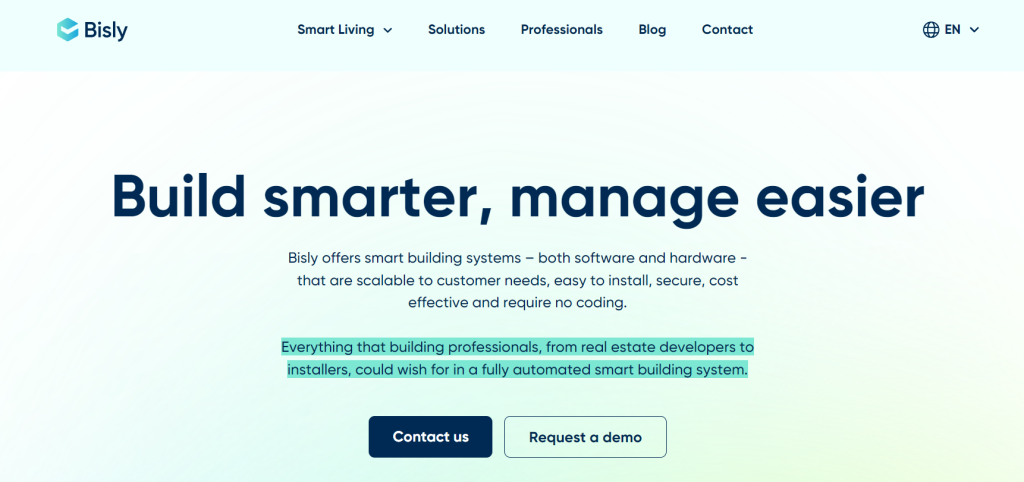
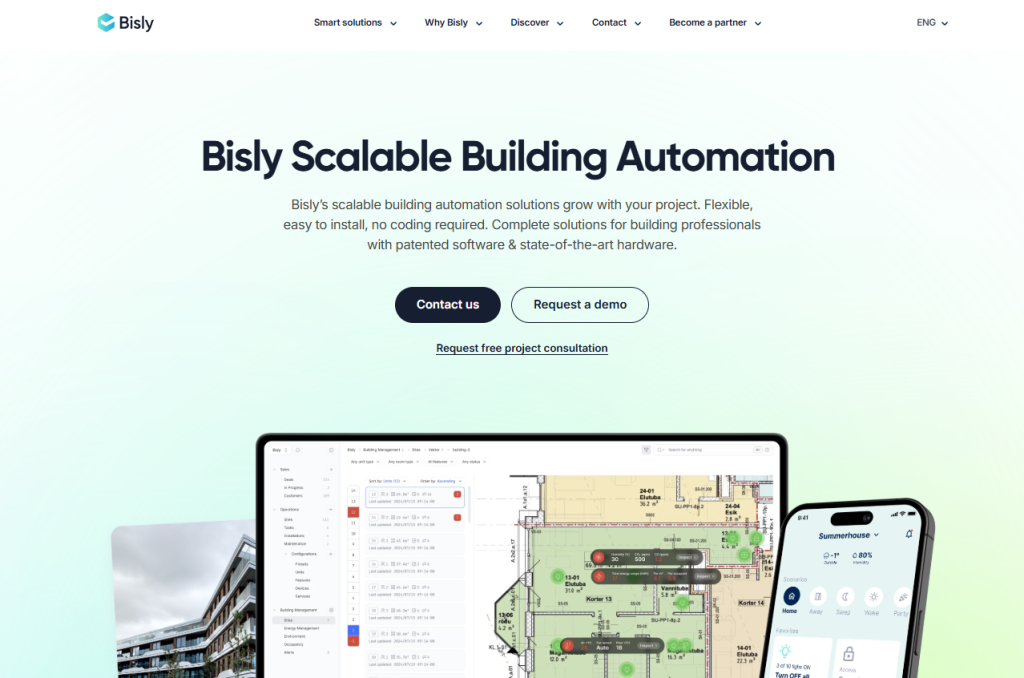
For Bisly, the problem was that smart building automation solutions were not really smart. They were difficult to manage and there was too much overhead in the process. I elaborated on this problem on the main page under the hero section.
I preferred to position the brand as offering hardware and software solutions that help construction professionals ‘build smarter, manage easier’, which was the key message.
The first image below is the ‘quick fix’ option for the company. Later, I took a more SEO-friendly, awareness-focused approach by saying what the product actually does, while retaining the previous message across different sections of the new site – see second image below.
4. What’s our brand’s personality?
This may sound like a typical workshop question which teams – except for marketing – find irrelevant and weird. But, well, it works.
If your brand were a person, who would they be? Is it the wise mentor, the innovative rebel, or the trusted friend?
How would your brand speak? Does it sound like a serious professional, a witty assistant or a loving friend? The examples can go on and on until you find the right one.
Your brand’s personality should infuse every aspect of your messaging, from the tone of voice to the choice of words and even the visual elements that accompany your copy.
Mini marketing warning
Nowadays, B2B marketing is increasingly blurring the lines with B2C.
Yet, many B2B brands still fall into the trap of using generic, overused phrases like ‘transformative experience’ and ‘cutting-edge technology.’
To truly stand out, focus on the unique value your product brings to your customers and avoid the cliché-ridden marketing jargon.

5. What are our competitors saying?
Another oldie but a goldie.
Understanding the competitive landscape is crucial. What messages are your competitors putting out there? How can you differentiate yourself?
Sometimes, the key to effective messaging is finding the white space in the market – the messages that aren’t being said but should be.
Sometimes it is a source of inspiration. Frankly, having worked in marketing for over 15 years, I can say that in today’s ultra-fast paced environment, we shouldn’t be reinventing the wheel.
Time is more valuable than money and we should use it wisely – not by saying ‘steal’, but by saying ‘learn from the successes and failures of others’.
Speaking of failures, there are times when competitors show us what not to do. We can learn from their mistakes and not repeat them in our own communications.
6. What’s our elevator pitch?
In the early days of my copywriting career, a mentor once told me that if I can write my advertising idea on a business card, then it is likely to have a concept and worth presenting to superiors.
Advertising becomes branding, branding becomes messaging, messaging becomes God knows what in the next six months, but one thing is certain that basics don’t change – the importance of refining the message.
Can you distill your core message into a compelling 30-second pitch?
If not, it’s time to refine your messaging. Your elevator pitch should be clear, concise, and intriguing enough to make someone want to hear more.
7. What emotions do we want to evoke?
Emotions drive decisions.
What feelings do you want your messaging to stir in your audience? Excitement? Relief? Confidence? Trust? Your choice of words, imagery, and overall tone should be carefully crafted to elicit these desired emotional responses.
And yes. It still applies to your business even if you are working in aerospace engineering and selling to enterprise.
Example:
Synctuation, one of the world’s first 3D sound meditation apps, is many things, but ‘relaxation’ is the key. That’s why the brand focuses on this aspect in its communication – whether verbally or visually through relaxing fastastic nature imagery.

8. What objections might our audience have?
You can come up with a great messaging strategy that covers the key aspects of your product, the problem you’re solving, and the needs of your target audience. It sounds right and looks great on paper.
But what if it doesn’t resonate with your audience?
No messaging strategy is complete without considering potential objections. What might stop your audience from engaging with your brand or product? Address these objections in your messaging to build trust and overcome hesitation.
Where should you do this? It could be a problem statement under the hero section on the main page of your website, a dedicated blog post on the ‘top x questions about product Y’, an FQA section – you name it
9. What’s our origin story?
There’s a reason 1 in every 10 people on LinkedIn has changed their title to “Storyteller” in the past few years.
Storytelling is a determining factor in a brand’s story. It shapes the brand world – people connect with stories.
What’s the story behind your brand or product? How did you come to solve this particular problem? Is there an appealing detail about how, why and where this first “evreka” moment of your product has taken place? Dig into it. Talk to the founder or co-founders, learn every aspect of this story and refine it.
Weaving your origin story into your messaging can add depth and authenticity to your brand narrative.

10. What proof points can we offer?
In a world of skepticism, proof matters.
Especially if your target audience knows they have a problem, are familiar with the product and have tried different solutions before.
What evidence can you provide to back up your claims? This could be in the form of case studies, testimonials, data, or awards. Incorporate these proof points into your messaging to build credibility and trust.
This is a question that can be answered together with sales (case studies, testimonials) and technical departments (product features, data).
They also will be your best friends when developing an SEO friendly content strategy.
11. How does our messaging align with our broader business goals?
Departments working in silos, messaging strategies existing in a vacuum – enemies of a company, be that a young startup or an old enterprise.
How does your messaging strategy support and align with your overall business objectives?
Whether you’re aiming for market expansion, increased brand awareness, or driving sales of a specific product, your messaging should be crafted with these goals in mind.
Back to the intro section
Always gather input first. Not just about the product or service.
But about the broader business objectives, including but not limited to
- Growth plans: are there any new markets on the horizon?
- Product plans: are we planning to launch any new features or products, and when?
- Communication issues: does our audience know we exist?
Depending on the industry and the type of company (VC-backed or bootstrapped, enterprise or SME), you may need to spend more time with the management team and delve deeper into the plans for the next few years.
12. What channels will we use to deliver our message
Different channels require different approaches. As obvious as it sounds, we marketers can’t always keep up with this simple rule, because of the fast pace and high expectations.
How will your messaging be adapted for various platforms – social media, your website, email campaigns, lead generation campaigns or traditional advertising?
If you have multiple target audiences, you may have multiple funnels. This means your potential users are finding you in different media. While you may want to reach out to top of funnel users with SEO based content, you can get in touch with enterprise in LinkedIn. How would you recycle your messaging and value proposition?
Each channel has its own nuances and best practices that should inform how you craft and deliver your message.
13. How can we make our message memorable?
This is one of the biggest challenges nowadays.
In a world of information overload, being memorable is key. What unique hooks, catchphrases, or visual elements can you incorporate to make your message stick?
Sometimes, it’s a clever turn of phrase or a bold visual that lodges itself in your audience’s mind.
14. How will we measure the effectiveness of our messaging?
As you start off with messaging strategy, you should also keep measurement in mind to find out the answer to this simple question – does it work?
What KPIs will you use to gauge the success of your messaging?
This could include metrics like engagement rates, brand recall, lead generation, or even direct sales impact. It also includes channel specifics.
Having clear metrics in place will allow you to refine and improve your messaging over time.
15. How does our messaging adapt across the marketing funnel?
This is where we enter the territory of marketing strategy, not just messaging.
One important aspect of a robust messaging strategy is understanding how it should evolve as your audience moves through the marketing funnel. Let’s break this down:
Top of the Funnel: Casting a Wide Net
At the top of the funnel, your audience is just becoming aware of their problem or need. They’re likely to find you through organic search or, if you’re running them, paid ad campaigns. Your messaging at this stage should:
- Focus on the problem-solution dynamic, but from a broad, relatable angle
- Use language that resonates with how your audience might describe their challenge
- Provide valuable, educational content that helps your audience understand their problem better
- Avoid heavy sales pitches; instead, position your brand as a helpful resource
For example, if you’re a productivity app, your top-of-funnel messaging might focus on common time management struggles and offer general tips for improving productivity, subtly hinting at how your solution fits into the picture.
Middle of the Funnel: Building Credibility
As your audience moves to the middle of the funnel, they’re actively evaluating solutions. This is where you want to amp up your credibility and showcase why your solution stands out. Your mid-funnel messaging should:
- Leverage social proof heavily – think customer testimonials, case studies, and success stories
- Dive deeper into the unique features and benefits of your solution
- Address common objections or concerns your audience might have
- Use your blog and social media channels to showcase thought leadership and expertise
For example, if your product is a clean tech product such as a building automation system or a solar roof, mid-funnel content could include user success stories, competitive comparisons, or in-depth guides on how specific features can solve specific problems and challenges.
Bottom of the Funnel: Sealing the Deal
At the bottom of the funnel, your audience is almost ready to make a decision. Your messaging here should:
- Provide clear, compelling calls-to-action
- Offer more direct comparisons with competitors, highlighting your unique value proposition
- Address any final objections or hesitations
- Emphasize the ease of getting started and the immediate benefits
- Consider offering incentives or limited-time offers to encourage action
If the product is martech, bottom-of-funnel messaging could include a free trial offer, a detailed ROI calculator or a step-by-step onboarding guide to show how easy it is to get started.
Bonus
How flexible is your messaging framework?
Things change.Things at startups change even faster.
Last but not least, consider the adaptability of your messaging strategy. Markets change, new competitors emerge, and customer needs evolve.
How easily can your messaging pivot to address new challenges or opportunities?
Building some flexibility into your framework ensures that your messaging remains relevant and effective in the face of change.
The Importance of Cohesion
While your messaging should adapt across the funnel, you should maintain a cohesive narrative. Your brand voice, key value propositions, and overall message should remain consistent, even as the focus and depth of your content changes.
Mini marketing warning
Don’t confuse adapting your message for different channels with completely changing your message in every channel.
Consistency is key, but that doesn’t mean using identical wording across all platforms.
Maintain cohesion while tailoring your approach to each channel’s unique characteristics, whether it’s organic social media or PPC campaigns.
Remember, real people don’t always move neatly through the funnel. Someone might encounter your bottom-of-funnel messaging first, or skip straight from top to bottom. Ensure each piece of content can stand alone while also fitting into the larger story you’re telling.
By thoughtfully adapting your messaging strategy across the marketing funnel, you create a seamless journey for your audience, nurturing them from initial awareness all the way to becoming loyal customers and advocates for your brand.
At the end of the day…
Crafting a messaging strategy is both an art and a science. It requires a deep understanding of your brand, your audience, and the broader market context. By working through these questions which you can tailor depending on the industry and company you are working at, you’ll be well on your way to developing a messaging strategy that resonates with your audience and drives real business results.
Remember, your messaging strategy isn’t set in stone. It’s a living, breathing entity that should evolve as your business grows and your market changes. Regularly revisit these questions to ensure your messaging remains fresh, relevant, and impactful.
Whether you’re a solo marketer juggling multiple responsibilities or part of a larger team, these questions can serve as your North Star in the sometimes chaotic world of brand communications. They’ll help you stay focused on what matters most: crafting messages that connect, engage, and inspire action.
Now, it’s your turn. Dive into these questions, explore the depths of your brand’s messaging, and emerge with a strategy that’s clear, compelling, and uniquely yours. Happy strategizing!